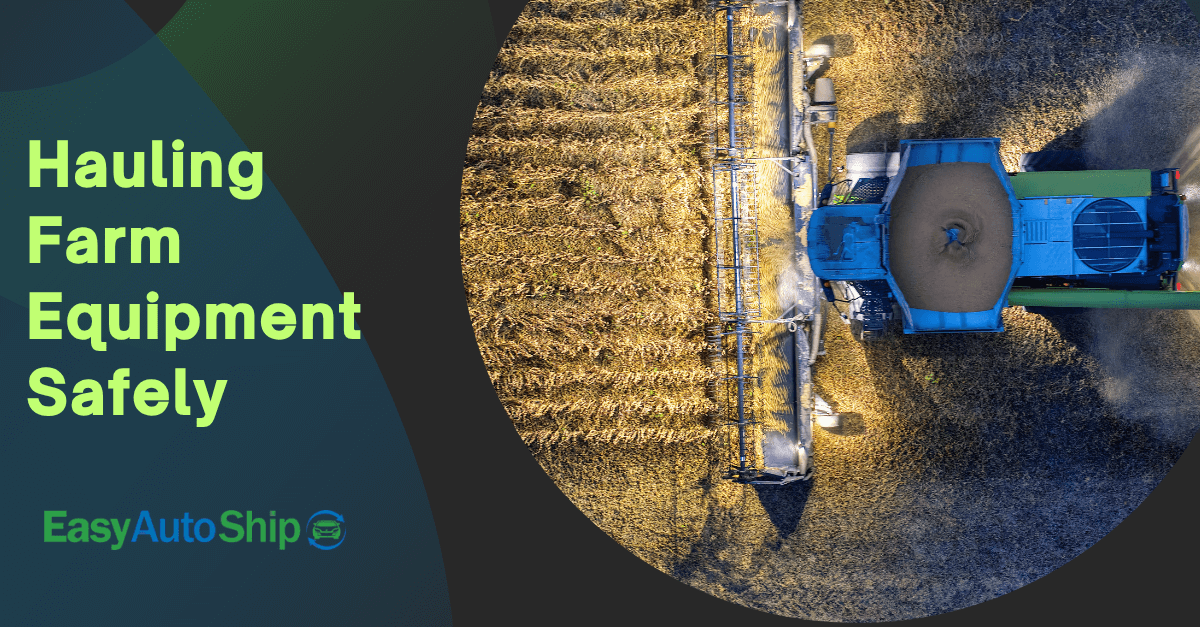
The heavy equipment shipping market is projected to reach $6.3 billion by 2025 and this growth is fueled by a consistent demand of the agricultural and construction sector.
However, due to the size and load of farming equipment, machinery and tractors, any mistakes with measurements, securement, permits, or insurance during transport can be risky.
This guide outlines how to prepare for farm equipment hauling, choose a reliable transport broker/carrier, meet legal requirements, and secure loads to keep equipment and people safe.

How to Transport Tractors and Machinery Safely?
Safely transporting heavy equipment to farms comes down to getting a few basics right.
Get an accurate measurement of the machine’s total dimensions and to see if it is under the legal requirements of under 8.5ft in width, 13.5ft in height (varies by state), and 80,000lbs in weight or if it’s oversized/overweight. This determines the legal status of the haul, and if there’s anything exceeding those limits, you would need to plan accordingly for the special permits, route surveys, and specific trailers.
Trailer Selection
Once you assess your vehicle, you must find a trailer that meets legal capacity and has vertical clearance based on the route. The trailer must be able to handle the weight of your equipment, must have a deck that’s suitable for loading and unloading the machine, and has enough axles to comply with federal bridge laws.
Hiring Transportation Service
A reputable broker would also be able to coordinate with a broad network of carriers, get needed permits and provide a smooth experience. They must have valid licensing and insurance, ample experience to handle oversize farm machines, the right equipment and specialized trailers.
Prepare the Machinery
You must prepare and secure the vehicle according to legal protocols, especially for long-distance hauling of heavy equipment. This is the final and most important part of the process before you ship the equipment because it helps prevent damage to the machine, trailer, roads and passersby.
Why is “Safe” Hauling so Important?
Typically, heavy equipment is transported on large trucks. Such trucks have seen a 43% increase in fatal accidents in the past 10 years.
Which makes one wonder, how do these modern, heavy-duty trucks, engineered with advanced fail-safes, and stability systems, end up in these situations, and what can one do to guarantee a safe outcome?
The majority of incidents are not caused by equipment failure but rather operator negligence. Specifically, when companies cut corners by disregarding weight limits, drive at unsafe speeds for “promised expedited delivery” instead of better time management, rushing the strict securement protocol, or not following US DOT hour limit requirements of driving a maximum of 11 hours after 10 consecutive hours off-duty.
Want a secure agriculture machine transport solution? Call (888) 687-3243 to speak to our team, ask any questions you have and receive free, no-obligation farm machine hauling quotes.
Selecting the Right Loading Trailer for Farm Equipment Hauling
Let’s take a look at the factors you need to consider when selecting a trailer and the type of trailers that would be best suited for the job.
Factors to Consider
To choose a trailer, you need to think practically. You would need to consider if it can fit your equipment and the roads and what loading method would it require.
Size and Weight of the Equipment
Many modern machines are oversized and extremely heavy. Wide combine headers or sprayer booms can easily exceed 8½ ft in width and heavy tractors can tip the scales over 20-30 tons. By regulation, any load wider than 8.5 ft or heavier than 80,000 lbs is considered oversize and requires special permits.
Think about the length, width, and height of the equipment. Besides the main body, you need to account for the exhaust, stacks, cabs, booms, sprayer arms, and header. The height also matters for bridge/overpass clearance, and the width for permits for restricted routes. For instance, according to the Texas Transport Code, a vehicle with height of more than 14 feet is restricted, unless a permit is obtained from the Texas Department of Motor Vehicles (TxDMV). In comparison, states like New York and Florida cap vehicle height at 13.6 feet.

Total Weight and Axle Loading
You need to know the total weight of your machine and the trailer’s axle setup to figure out if the trailer can legally and safely carry your load.

Many people make the mistake of looking only at the Gross Vehicle Weight Rating (GVWR). While the GVWR tells you the total allowed weight of the trailer plus its cargo, it does not tell you how much machinery you can actually load. To find the true Payload Capacity, you must do a simple calculation:
Payload = GVWR - Trailer Empty Weight
If your farm machinery weighs 10,000 lbs, but your 14,000 lb GVWR trailer weighs 5,000 lbs empty, you only have 9,000 lbs of payload available. In this case, loading the machine would be illegal and unsafe.

Once you know the total weight fits the GVWR, you must check the Gross Axle Weight Rating (GAWR). GAWR is the maximum weight each axle can safely carry. Because trailers often have more than one axle, the load must stay within both the total GVWR and the individual GAWR for each axle.
The axle count and spacing tell you how much weight the trailer can legally put on the road. More axles spread the weight out, which reduces stress on the bridge and pavement and allows carriers to load heavier equipment without going above the single axle’s limit.
You can see that in the illustration below. In figure A, the weight is disturbed across the long 80,000 lb trailer. The trailer has wider axle spreading, so there is less concentrated force on the bridge. However, in the shorter 80,000lb trailer, there is a heavier load on the bridge due to the shorter wheelbase.

This is exactly why bridge laws exist and axle spacing matters.
Note: GVWR, Payload, and axles always go together. If the equipment is too heavy for either, the move becomes illegal, unsafe, and requires a bigger trailer or a multi-axle setup.
Operational Condition
Farm equipment hauling is different for operable and inoperable equipment. If it works, steers and brakes properly it can be driven or winched onto the trailer easily. However, for non-operational tractors and machinery, or heavy attachments such as plows, cultivators and harrows, the carrier would need extra equipment such as a forklift, crane or a larger winch. It also may cost more to load non-working equipment as it requires more time and labor.
Road Permits and Constraints
Short local moves are easier, however longer ones need more planning.
As discussed earlier, every state has its own legal limits on height, weight, and width. You need permits and clearance for shipping farm machinery. Some roads also have time-of-day restrictions and holiday bans.
For example, in Washington oversize and overweight loads cannot travel during night hours, major holidays, or commuter-traffic curfews in metro areas. However, Oregon generally allowed night travel, except for larger overwidth loads that need special approval or route-specific clearance.
On other routes, even if you are permitted to transport a 14-foot equipment/trailer, there could be a bridge where only 10 feet can pass. That means, even tall and heavy roads may also have low bridges.
For example, this diagram shows how much height you have under a bridge at different points across the roadway, so you can tell if your tall equipment/trailer can pass safely.

In those instances, the carrier company would need to either plan special routes to avoid these limits, or suggest a trailer that can carry your equipment and also get required permits to do so. This may change the travel time and cost.
Note: Do not shortcut permits or regulations. The fines and delays for illegal hauling can be severe. Always assume you need a permit if dimensions are near the limits.
Loading and Unloading Site Conditions
Farm equipment is most likely to experience some unfavorable site conditions. So, in this case, pick up and drop off locations matter a lot. Soft soil, tight corners, slopes, overhead wires, and even low tree branches can add difficulty to the agricultural equipment transport process. For locations that don’t have docks or the carrier might bring a dock along, or suggest a trailer with its own loading system.
Trailer Deck Height and Loading Angle
The deck height dictates how safely a vehicle can be loaded onto the trailer. For a low-clearance vehicle, you need a trailer that allows you to drive heavy tracks directly onto the deck with almost zero incline stress. For instance, both the John Deere S-Series combine and a self-propelled sprayer have low ground clearance. Using a standard flatbed that is 1.5 meters up from the ground wouldn’t be suitable. Instead, it is best to use a Removable Gooseneck (RGN) trailer, as its decks sit just 18-24 inches off the ground.
7 Common Types of Far Hauling Trailers Explained
Most farm equipment hauling is done on open-air flatbed trailers, but you still need to know which is the right one.
- Standard Flatbed: Open deck, no drop. Good for smaller tractors/implements that fit within height limits and can be winched or driven on. Quick loading if ramps are available.
- Step-Deck (Drop-Deck): Rear deck lower than the front. Use for taller machines like those with higher exhausts or cabs where reduced deck height avoids clearance problems.
- Removable Gooseneck (RGN): Front detaches so the trailer’s front end lowers to form a long ramp. Ideal for very tall, heavy, oversize equipment. You can drive heavy machinery without steep angles using this.
- Lowboy / Low Deck: Extremely low deck height and heavy-duty axles. Used for the heaviest tractors, combines, and machinery where center of gravity and deck height are critical.
- Extendable Flat / Extendable Step-Deck: Length can be extended for long items such as long headers, irrigation pipes. Useful when machine length exceeds standard trailer lengths.
- Multi-Axle Float / Heavy Haul Trailer / Modular: This has multiple axles and often a hydraulic system which is used for super-heavy equipment that go beyond the GVWRs standard.
- Tilt Trailer: In this trailer, the deck tilts to make it easier for the equipment to be rolled on and off. Most suitable for smaller wheeled equipment that the operator can drive without complication.
Note: Legal road limits (80,000 lbs in most US states for total GCWR) often restrict actual hauling capacity below trailer ratings.

Here’s a quick table comparing technical aspects of common farm equipment hauling trailers:
| Trailer Type | Typical Deck Height | Typical Capacity / Range | Best Use Examples | Typical Loading Method | Notes/Limitations |
|---|---|---|---|---|---|
| Standard Flatbed | Medium like a standard truck bed | Varies but 20,000 to 30,000 lbs | Small tractors, implements, combine headers when detached | Drive-on, winch, ramps | Fast, versatile; height limits apply |
| Step-Deck (Drop-Deck) | Lower rear deck (2-3 ft lower) | Similar to flatbed but can handle taller loads | Taller tractors, medium combines | Drive-on, ramps | Good for extra height clearance |
| Removable Gooseneck (RGN) | Very low when deployed | 30,000-80,000+ lbs but heavy haul RGNs give higher capacity | Large tractors, harvesters, heavy machinery | Drive-on via detachable gooseneck ramp | Excellent for heavy/oversize; needs skilled driver |
| Lowboy / Low Deck | Very low and near ground | 40,000-100,000+ lbs with multi-axle | Extremely heavy tractors, large combines | Drive-on, sometimes ramps or loading from rear | Lower center of gravity; may need permits |
| Extendable Flat | Medium to low | Varies; length adjustable | Very long loads like headers, booms and pipes | Drive-on/winch; may require special rigging | Length adjustable but watch balance & support |
| Multi-Axle Float / Modular | Medium to low with many axles | 80,000 lbs to several hundred thousand lbs | Super heavy loads, oversized equipment | Drive-on using ramps or gooseneck | Requires escorts and permits; can be expensive |
| Tilt Trailer | Medium | Up to 15,000 to 25,000 lbs | Small wheeled equipment, tractors that can be driven | Tilt + drive-on without separate ramps | Quick loading; not for extremely heavy gear |
Choosing a Reputable Carrier or Broker for Farm Machinery Shipping
Before hiring a tractor hauling service for a safe transportation, you must ensure the following:
- Licensing and Insurance: It is absolutely necessary to confirm that your chosen carrier has valid DOT/MC number and up-to-date insurance. It is required and stimulated by the Federal law that a carrier may carry a liability insurance of no less than $750,000 and if the carrier carries hazardous materials then this amount increases to $5M. For this reason, reputable brokers will have all the necessary credentials and bonds like the BMC-84/BMC-85 always available for inspection.
- Experience and Equipment: Look for companies experienced in oversize farm shipments. Read reviews to confirm they handle tractors/harvesters often. They also must own or lease the right trailers like multi-axle lowboys, extendable flats. An expert hauler will deploy the correct trailer type for your machine’s height, weight and drive-off capability.
- Tracking & Communication: A good transporter provides GPS tracking and updates so you know progress.
- Nationwide Carrier Network: Brokers leverage a broad network of carriers and backup rigs. This includes brokers who coordinate trucking companies, permits and escorts. In other words, a broker shops your job to multiple carriers to find the best match, rather than you calling individual firms.
By contrast, hiring a random flatbed driver may backfire if they lack experience. Don’t sacrifice safety for price. A trusted broker/carrier in this niche will often charge more per mile. $3-$8/mi is typical but that price includes insured, well-secured transport.
Easy Auto Ship is a licensed car shipping broker with proper, verifiable DOT/MC Number. Call (888) 687-3243 to speak to our team, ask any questions you have and receive free, no-obligation farm machine hauling quotes.
How to Secure the Farm Equipment To Trailer
As per the Federal cargo securement rules (49 CFR §393), you are legally mandated to secure heavy equipment so that it is immobilized to prevent it from shifting or falling during sharp turns and sudden stops.
Not only is this important for the safety of the vehicle, but also for the safety of passersby.

Key best practices include:
- Tie-Downs and Chains: Use heavy-duty, FMCSA-rated binders and straps. For very heavy, rigid machines, steel chain tie-downs with a high Working Load Limit (WLL) are recommended. Softer straps work on lighter components, but ensure they’re not frayed. Distribute tie-downs symmetrically and use enough attachments. At least four for a tractor is common. Edge protectors help prevent chains from cutting.
- Weight Distribution: Load the tractor so its heaviest parts are centered on the trailer bed. Keeping the center of gravity low by placing heavy wheels or attachments on the trailer floor. This prevents rollovers in corners or wind gusts. Nothing should overhang too much at the back or front of the trailer but should tightly confine within the trailer rails.
- Blocking and Bracing: Place wooden blocks, timber dunnage or metal wedges against wheels and axles to stop any movement. Use chocks behind wheels and braces under protruding parts. These simple measures help counteract inertia. Even light loads must be secured. Unsecured cargo causes over hundreds fatal truck crashes yearly. Don’t make assumptions: even if your tractor is low to the deck, tie it down tightly.
- Inspection During Transit: Regulations require a driver to inspect the cargo and tie-downs within the first 50 miles and then every 150 miles or 3 hours driving thereafter. As an owner, you should also request updates. A good carrier will stop to retighten straps as needed.
- Protect Fragile Components: Tractors have delicate components like the GPS units, hydraulics and fine machinery must be protected. For example, guidance electronics and monitors can be easily jarred, so operators must cover or shield such parts during transit.
Finally, attach any required safety alert like a large “WIDE LOAD” or “OVERSIZE LOAD” yellow-black or neon signs yellow across the front of the towing vehicle and rear of the load, plus 18-inch red/orange warning flags at all corners and protrusions. If moving at night or in poor visibility, amber flashing lights are used at load extremities. All these warnings keep other drivers alert and cautious about your wide and heavy cargo.
Want to avoid all the hassle and get a door to door far machinery shipping solution? Call (888) 687-3243 to speak to our team, ask any questions you have, and receive free, no-obligation farm machine hauling quotes.
Preparing Farm Equipment For Tractor Hauling Service
Before pick-up, thoroughly ready the machinery for road travel. The recommended steps are:
- Clean and inspect: To avoid road spray damage, remove any accumulated dirt, mud, crop debris and other detritus from the vehicle and even the undercarriage. This also allows you to notice and document any pre-existing damage.
- Secure or remove attachments: Because the dimensions of the equipment matter, it is important to remove all attachments that increase overall size such as the wide headers, booms, plows, dual wheels, etc.. For items that can not be removed, like the hydraulic arms, blades, etc., it is best to secure them in place so that they don’t swing and slip.
- Drain fluids: Check with the carrier about the fluid level requirements. Typically, they would ask you to keep the fuel under 25% and to lower water or chemical tank levels. Some carriers also require you to fully drain the tanks, especially if the equipment has hazardous liquid chemicals or is a dense load.
- Battery and safeguards: To prevent accidental shorts during travel, it is important to disconnect and secure the batter and other electronic monitoring and tracking devices. Ensure all toolboxes and compartments are locked, so that they don’t fly away on the highway due to wind or vibration during high-speed transits.
Easy Auto Ship Removes The Confusion Out of Farm Equipment Hauling
To transport any vehicle, careful preparation is important. For transporting heavy equipment to farms, you need to be extra careful by choosing the right carrier or broker, following all regulations, getting the required permits, and securing the equipment safely. If you want to cut through all the hassle, permit work, and logistics, Easy Auto Ship offers A-Z door-to-door agriculture equipment transport solutions. Call (888) 687-3243 to speak to our team, ask any questions you have and receive free, no-obligation farm machine hauling quotes.
Frequently Asked Questions
What to do when the vehicle arrives at its destination?
Start with a visual inspection to ensure everything has reached scratch-less. Then accurately place the ramp for offloading. Ensure it’s placed with accuracy as you can’t change positions once the equipment is backing up. Once everything is in place, the experts will slowly unload the equipment. Finally conduct a final inspection before letting the team go.
How much does it cost to transport heavy farm equipment?
Costs vary by distance, weight, and special services. Average base rate for something like a Large Crawler Dozer would be $5 per mile. Fuel surcharge, permits, escort vehicles, tolls, route fees, and additional services like expedited shipping, loading cranes, or liftgates add to the cost.
How long does transporting a tractor or heavy equipment usually take?
Timing depends on several factors such as the distance, the route taken, obtaining permits and arranging any required escorts. There can also be weather delays, or delays due to holidays. Carriers can often provide an estimated date after considering all of this.
Is the carrier’s insurance enough, or should I buy extra?
Confirm whether or not the carrier’s insurance matches your equipment value. If you feel your machine is worth more than their offered coverage, you can always consider additional insurance or a declared-value rider. This way you can get a full reimbursement in case of any damage or loss.
Why should you map the best route before farm equipment hauling?
It helps you ensure that there are no obstacles during transportation such as an underpass that’s too low for your vehicle. Choosing a route with fewer turns, starts, stops, bridges, or challenging terrain keeps the equipment and passerby safe and the trip smooth.